




Stepping Motor Station
PV-7700 Pro System

The PV-7700 is capable of high-accuracy measurement with an angular resolution of 1/10000º (this scale is dependent on the encoder resolution) and enables ±0.5% of the detector’s full scale torque measurement accuracy.
In addition to that, by setting motor drive output pulse at 800kHz, the PV-7700 meets specification for the micro-step stepping motor.
|
Before watching this movie, please make sure MacromediaFlashPlayer in your browser. If this application is not there, visit Macromedia download center and get FLASH PLAYER download, please. |
 |
Features
Measurement of seven important torque and angle characteristics with one device
Dynamic torque characteristics |
Pull-in torque, pull-out torque |
|---|---|
Static torque characteristics |
θ-T, holding torque, detent torque |
Angle characteristics |
Damping characteristic, angular accuracy |
· Easy-to-use detector
· Automatic measurement
· High-accuracy measurement
Torque : ±0.5 % of the detector’s full scale, Angle : ±0.01 °
· Data output that is easy to use with Excel and Word applications
Graphs can be output using the Clipboard function, and numeric data output directly to an Excel worksheet.
· Various types of stepping motors supported
The torque detector can be selected from a wide line-up of models ranging from 0.01 N•m to 20 N•m. The PV-7700 system can be used with various motor drivers owing to the versatility of the high pulse output.
Configuration / Block Diagram

Examples of data

Pull-in Torque
Up to 50 measurement points can be set, while the output clock setting can range from 1 pps to 800 kpps. This function measures the synchronous rotating torque at the frequency set for each of the points while automatically reducing the braking force. The measured results are displayed as a curve using spline interpolation between the data points on the graph. The pull-in torque curve can be displayed on the same screen as the pull-out torque curve.
Pull-out Torque
This function measures the synchronous pull-out torque at each of the measurement frequencies while automatically increasing the braking force. The number of measurement points and the output clock setting range are the same as those for the pull-in torque. An acceleration (slow-up) setting for the output clock can also be made. The measured results are displayed as a curve using spline interpolation between the data points on the graph.
Detent Torque (Holding Torque without Excitation)
This function measures the angle and torque over one complete rotation (360°) while the motor is not excited. The PK detector measures the torque while rotating the shaft at a slow rotation rate of 1 r/min. The maximum and minimum values of both the peaks and the valleys are displayed.
Damping Characteristic (Step-response Characteristic)
This function measures transient response characteristics using an angle detector. The sampling rate can be set anywhere in the range from 10 µs to 1 ms, and the number of samples up to 16384 (depends on the sampling rate used). Cursor operations can also be used to display the angle difference and the time difference between any two points. A PK Series detector can also be connected and used to apply the desired load.
θ-T Characteristic (Angle vs. Torque Characteristic)
This function measures the angle and torque for the specified range. Measurement is performed on an excited motor without pulse input. The PK detector measures the angle vs. torque characteristic while rotating the shaft at an extremely slow rotation rate of approximately 0.06 r/min. The display can also be changed so that the stable point is at the center.
Holding Torque (Maximum Static Torque during Excitation)
This function measures angle and torque over one complete rotation (360°) while the motor is excited. The PK detector measures the torque while rotating the shaft at a slow rotation rate of 1 r/min. The maximum and minimum values of both the peaks and the valleys are displayed.
Angular Accuracy
This function enables the measurement of stationary angle error, step angle error, and hysteresis error. Each error value is automatically calculated and displayed. High-speed measurement at a feed speed of 1 to 50 pps is enabled. If an RK Series detector is used, highly accurate measurement (±0.01°) can be performed.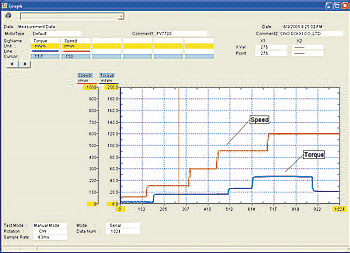
Manual Mode
This mode enables continuous operation and measurement according to the output clock and load specified using the PK detector key input functions. Any of the input values can be changed during operation. The sampling rate can be set anywhere in the range from 4 ms to 1 s, and the number of samples up to 1024.Specifications
PK Series Torque Detectors
| Model name | Detector capacity | Moment of inertia | Brake power | Detector shaft diameter |
|---|---|---|---|---|
| PK-102A [Discontinued] |
10 mN•m | 10 gcm2 | 13 W | 3 mm |
| PK-202A [Discontinued] |
20 mN•m | 10 gcm2 | 13 W | 3 mm |
| PK-502A [Discontinued] |
50 mN•m | 14 gcm2 | 13 W | 5 mm |
| PK-103A [Discontinued] |
100 mN•m | 27 gcm2 | 25 W | 5 mm |
| PK-203A [Discontinued] |
200 mN•m | 27 gcm2 | 25W | 5 mm |
| PK-503A [Discontinued] |
500 mN•m | 147 gcm2 | 35 W | 8 mm |
| PK-104A [Discontinued] |
1 N•m | 147 gcm2 | 35W | 8 mm |
| PK-204A [Discontinued] |
2 N•m | 546 gcm2 | 50 W | 8 mm |
| PK-504A [Discontinued] |
5 N•m | 1.7 kgcm2 | 60 W | 14 mm |
| PK-105A [Discontinued] |
10 N•m | 6.6 kgcm2 | 120 W | 14 mm |
| PK-205A [Discontinued] |
20 N•m | 6.6 kgcm2 | 120 W | 14 mm |
| Rpm measurement range | 0 to 3000 r/min 0 to 2000 r/min (PK-504A, 105A, 205A) |
|---|---|
| Torque detection method | Magnetic phase-differential system |
| Torque measurement accuracy | ±0.5 % of full scale |
| Internal drive speed | 0.06 r/min or 1 r/min, selectable |
| Braking | Powder brake system |
| Operating temperature range | 0 to +40 °C |
| Power supply | 100 to 240 VAC ±10 %, 50/60 Hz |
| Power consumption | These specifications differ for each model. |
| Accessories | Power cable, signal cable |
Model name |
RK-820 [Discontinued] |
RK-830 [Discontinued] |
|---|---|---|
| Detection method | Optical phase-differential system | Optical phase-differential system |
| Shaft configuration | Dual shaft | Dual shaft |
| Diameer of detector shaft | 5 mm for both ends | 12 mm for the motor side 8 mm for the PK detector side |
| Moment of inertia | 17 gcm2 | 29 gcm2 |
| Allowable torque range* | 50 mN•m or less | 500 mN•m or less |
| Angle detection accuracy | ±0.01 ° |
|---|---|
| Angular resolution | 5000 P/R; multiplied to 100,000 P/R within the PV-7700 |
| Operating temperature range | 0 to +40 °C |
| Power supply | Supplied from the PV-7700 |
| Accessories | L-shaped mounting fixture, signal cable Note : Couplings are not supplied |
PV-7700 Torque-Angle Meter
| Measurement parameters | Torque, angle, analog input signals | ||||||||
|---|---|---|---|---|---|---|---|---|---|
| Measurement accuracy | Torque : ±0.5 % of full scale (1-s average value) Angle : ±0.01 ° (when an RK Series angle detector is used) Analog input : ±0.2 % of full scale |
||||||||
| Sampling time | 4 ms to 1 s (10 µs to 1 ms when Damping measurement is performed) | ||||||||
| Measurement functions | 1. Pull-in torque, 2. Pull-out torque, 3. θ (theta)-T characteristic, 4. Holding torque, 5. Detent torque, 6. Damping characteristic, 7. Angular accuracy | ||||||||
| Torque signal input section | Output signal from a phase-differential detector | ||||||||
| Angle signal input section |
|
||||||||
| Analog signal input section | ±10 VDC, 4 channels, 16-bit A/D converter | ||||||||
| Motor driver interface | Output configuration : Open collector (24 VDC, within
32 mA)
Output signal : Rotational direction signal, clock pulse Excitation on/off command signal Power supply output for the interface (switched between 5 V and 12 V) Clock frequency : 1 Hz to 800 kHz |
||||||||
| PK detector interface | Two channels (two further channels can be added as an option.) | ||||||||
| Computer (for connecting to the PV-7700) | Sold separately
OS (operating system): Windows XP Professional
Edition |
||||||||
| Operating temperature range | 0 to +40 °C | ||||||||
| Power supply | 100 to 240 VAC ±10 %, 50/60 Hz | ||||||||
| Power consumption | 70 VA or less (at 100 VAC) | ||||||||
| Weight | Approx.10 kg | ||||||||
| Accessories | Power cable, USB cable, connector for motor driver signal output, PV-7700 application software | ||||||||
| Options
(Sold separately) |
This option is built into the PV-7700. Two channels are added to the detector’s connector.
|
Revised:2005/10/22

