When the sampling interval is Δt seconds (sampling is made every
Δt seconds), the sampling frequency, fs, is 1/Δt (1/Δt points
are sampled a second.) Sampling theory indicates the
relationship between a temporally continuous signal and the
least possible sampling rate with which the original information
can be maintained. It prescribes that the sampling frequency
must be at least two times the highest harmonic component
contained in the signal. If the sampling frequency is lower than
two times the signal frequency, aliasing (aliasing noise)
occurs.
Sound Intensity (SI) or
Acoustic Intensity (AI)
The sound intensity is the energy of sound which passes a unit
cross-section area, including the sound field point, within a
given unit of time. It is defined as a vector quantity which is
the time average of the product of the sound pressure at point p
(t) and the particle velocity, ur (t), into direction
r. If the sound intensity into direction r is Ir, the
following expression is given.
In a steady medium with a density of ρ, the relationship between
p(t) and ur(t) is represented by expression (2).
However, it is very difficult to measure the
particle velocity directly and correctly. To solve this problem,
a method to approximate the particle velocity from the
difference between sound pressures of two points was considered.
This method is the SI measurement method based on two
microphones. Using sound pressures p1(t) and p2(t)
of the two microphones which are separated by ⊿r into direction
r, p (t) and can be obtained as an approximate value:
When substituting expression (4) into expression (2), the
particle velocity into direction r, ur(t), can be
represented by expression (5).
Then, the sound intensity, Ir, is
This expression calculates Ir directly in the time
domain and is referred to as the direct integral method.
In addition, in many cases expression (7) is used to obtain Ir into direction r at any desired frequency band from f1 to f2
where Im{G12(f)} is the imaginary part of the
(one-side) cross spectrum of p1(t) and p2(t).
If you obtain the cross spectrum between sound pressure signals
at two close points using a 2-channel FFT analyzer and then
calculate the above expression using the imaginary part, you can
obtain the frequency band Ir for any desired
frequency band. This approach is referred to as the cross
spectrum method. Measurement errors of the SI measurement
method include the limited differential error by limited ⊿r, the
sensitivity between two microphones, and the error caused by
mismatched phase. Various considerations are made on this
correction method.
The following are sample applications using the SI measurement method.
(1) Measuring power level of sound source
The sound intensity represents the amount of sound energy
passing in a unit area in a unit time. The total power, P,
emitted from the sound source is given by
(Iri is the sound intensity vertical to plane si,
and si is the i-th area.)
The above expression allows you to calculate the sound power
based on sound intensity measurement at a split plane, on a
hemisphere centering on the sound source and into the direction
which is vertical to the surface of the hemisphere.
(2) Sound shield measurement
Through measurement of the transmission power for each section
based on SI, you can make quantitative measurement of the sound
shielding characteristics of walls consisting of multiple
sections and the sound leakage from gaps. Therefore, the SI
method is effective for sound shield measurement on site.
(3) Sound field analysis
The SI value is a vector quantity (a quantity with a magnitude
and direction). Therefore, by displaying the propagating
direction and the magnitude of the sound in 2D or 3D form, you
can visualize and capture the flow of sound energy.
Time-Axis
Differential/Integral
Differential
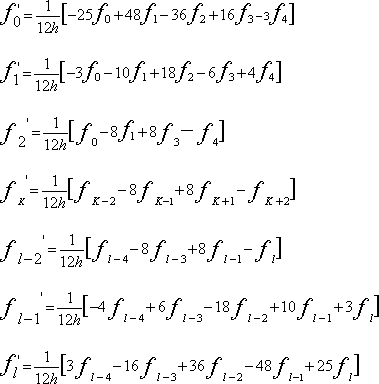
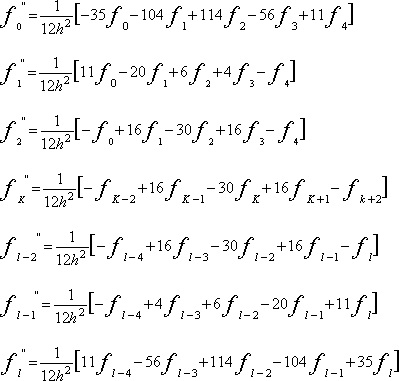
For calculation of the first and second order differential
values, the 5th order Lagrange's interpolation formula is used.
The data for a given point is obtained based on the value of the
five points before and after the target point, including that
point.
f0, f1,
f2,
f3,
f4,
.... are sample data.
First order differential
Second order differential
Integral
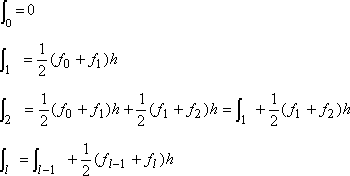
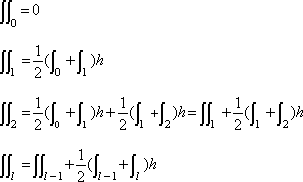
For calculation of the single and double integral values, the
trapezoidal formula is used.
Expressions for single integral value
Expressions for double integral value
Time-Axis Waveform
The instantaneous waveform of the signal input from the input
connector of the panel is displayed. The waveform for one frame
is displayed. In this case, the X axis is assigned time
(seconds) with the starting point of the frame set to 0 and the
Y-axis the instantaneous value. The full scale of the X axis is
set in conjunction with the frequency range setting.
Time Waveform
Statistical Calculation
(1) Mean value (MEAN)
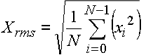
(2) RMS value (RMS)
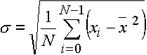
(3) Standard deviation (S.D.)
The 2nd order moment around the mean value is referred to as
the dispersion, and the square root of the dispersion is
referred to as the standard deviation. As for a signal excluding
the DC component, the RMS value and standard deviation are
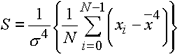
equal. The S.D. is obtained by
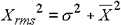
The relationship of expressions (1), (2), and (3) is
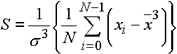
(4) Skewness (SKEWNESS)
Skewness denotes the 3rd order moment around the mean value
normalized by σ3. It is used as an index for
asymmetry around the mean value. Skewness is obtained by
(5) Kurtosis (KURTOSIS)
Kurtosis denotes the 4th order moment around the mean value
normalized by σ4. It is used as an index for
sharpness of waveform. Kurtosis is obtained by the following formula. Since the value of kurtosis in the time signal of a normal (Gaussian) distribution is 3, the value of kurtosis can be taken as the following equation minus 4.
(6) Crest factor (CRESTFACTOR)
Obtained by dividing the maximum value by the RMS value.
Trigger Function
The trigger function is a function which starts sampling based
on a certain point of an input signal or input of an external
signal.
There are two types of trigger modes: internal
trigger mode and external trigger mode. In the internal
trigger mode, the input signal is used as a sampling start
timing signal or trigger signal, and sampling starts when the
input signal reaches a specified voltage. In the external
trigger mode, an external signal is input as a sampling start
timing signal, and sampling starts when the external trigger
signal is input.
This function makes it possible to efficiently sample and
analyze a desired waveform portion. When averaging a time
waveform, the trigger function is used for waveform
synchronization.
Trigger polarity
......
Trigger is activated in three
different cases: when the signal rises and reaches
the specified voltage (+), when it falls and reaches
the specified voltage (-), or in both cases.
Trigger position
......
Specifies the number of points
before or after the trigger point, at which sampling
start. The trigger mode in which sampling starts
before the trigger point is called pre-trigger, and
the trigger mode in which sampling starts after the
trigger point is called post-trigger.
Trigger level
......
Specifies the voltage level at
which the trigger is activated.
Trigger type
......
Single trigger, repeat trigger, and one-shot trigger
Single trigger
When trigger is activated, one frame is
sampled and then capturing stopped.
Repeat trigger
Each time trigger is activated, one
frame is sampled. Trigger pulses appearing
during sampling are ignored.
One-shot trigger
Once trigger is activated, the
trigger-free condition (in which trigger is
not activated) results.



 can be obtained as an approximate value: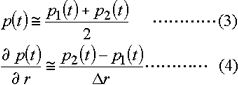



 (Iri is the sound intensity vertical to plane si,
and si is the i-th area.)
(Iri is the sound intensity vertical to plane si,
and si is the i-th area.)