


- HOME
- Ono Sokki's Patio
- Pascal and Decibel


Pascal and Decibel
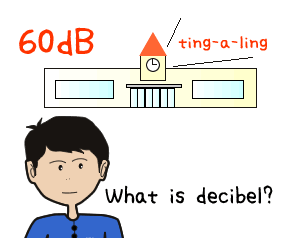
Ken: It is said that there was a complain by a neighbor that school announcement broadcasted at schoolyard was too loud. The noise level was 60dB. You said 60dB in talking about reverberation time. I thought I understood it at that time but I wonder if there is a difference between the noise level at school and what you said though it seems to be the same 60dB.
Dad: I did not tell you what kind of unit the decibel is. Now I will tell you from the first step, how a sound occurs and what kind of unit is used for such energy.
Ken: Dad, you told me that sound is vibration of air, didnt you?
Dad: Yes, I did. More precisely speaking, the average of air pressure is called atmosphere pressure and if there are parts with higher pressure and lower than the atmosphere pressure, they are conveyed as waves, which are called sound. When you hit on a desk, it makes sound. This is caused by the vibration of a desk, which shakes the air making high air pressure part and low pressure part.
Ken: I dont understand for sure how the air vibrates.
 Dad: You have done an experiment of spring scale
in a science class, havent you? Think you put a weight
on a spring scale. If you release the weight after
pulling it, both a spring and a weight vibrate up and
down. In order to vibrate, it needs both a spring and a
weight. Take a string of a guitar for example. The
characteristic which revert back to the first place is
that of a spring and the weight of a string is a plumb.
Dad: You have done an experiment of spring scale
in a science class, havent you? Think you put a weight
on a spring scale. If you release the weight after
pulling it, both a spring and a weight vibrate up and
down. In order to vibrate, it needs both a spring and a
weight. Take a string of a guitar for example. The
characteristic which revert back to the first place is
that of a spring and the weight of a string is a plumb.
Ken: I understand that it needs a spring and a weight for vibration but does the air vibrates with a spring and a weight?
Dad: Yes. If you push a ball, it will revert back. Air has a characteristic of a spring and it has weight. A balloon floats in the air because the hydrogen or helium inside is lighter than air.
Ken: I see. When you fan, you feel resistance, which is because of weight of air, I guess.
Dad: Yes, it is. Since air has characteristic of a spring and weight, it can vibrate. Then, sound travels through the air.
Ken: OK, but what Im still quite not sure is how vibration causes sound traveling.
Dad: Assume that you hit on a desk and it vibrates and the air around it is compressed. The air compressed gets thickened causing the air higher pressure than that of around. The air pushes the neighboring air which gets another pressure to push the neighboring repeated like a domino effect. This is how sound travels.
Ken:I understand now. The sound is vibration of air.
Dad: In this way there are parts of the air with high pressure and low. The amount of pressure change is called sound pressure. The unit is pascal (Pa).
Ken: Isnt the unit of sound dB, is it? What you have told me so far is dB, isnt it?
Dad: Decibel is a unit which you can handle sound pressure with 2-3 digits conveniently. The standard of sound pressure is set up to be 20 micro pascal (μPa) which is almost same as the pressure of the smallest sound human being can hear. 1(one) atmosphere is about 100,000 pascal. So it is a very small change of 2/10 billion of 1 atmosphere.
Ken: How does it come to be only 2-3 digits to express the same pressure?
Dad: The smallest sound or 20 micro pascal means 20/1 million and the ear-splitting noise is approx.20 pascal. Sound pressure has a wide range of 1million times than pascal does and this is really inconvenient. You will learn in math that decibel is expressed with log. Log of ratio of sound pressure P of a certain sound and the standard sound pressure raised to the 2 power is the level of sound pressure. (See the formula *1)
Ken: It doesnt come to me clearly but I understand a unit expressing a range of 1 million numerically with 2-3 digits is a sound pressure level.
Dad: According to this formula, 10 times of sound pressure is 20dB of sound pressure level and 1 million times of sound pressure is 120dB of sound pressure level. A loud sound of 120 dB is 20 pascal in pressure. This is 20/100,000 of one atmosphere telling you it is a slight vibration of the air even though it is a loud sound.
Ken: Oh, I see. What is the difference between the two 60dB, reverberation time and noise level?
Dad: 60dB of reverberation time is a relative amount. Assume that there is a sound in a space and its sound level is 100dB. When you stop sounding, there remains some sound rebounding on walls or ceilings in the space and vanishes gradually. Time required for rebounding sound to decrease by 60dB (1/1000 of sound pressure) is the reverberation time. In this case, it is the time till the level of sound pressure decreases to 40 dB. Acoustic sense of human being is impervious to low sound and sensitive to high sound of around 2kHz. Sound pressure level as a result of frequency-corrected is called noise level and it is 60dBA (See *2). I will talk about noise level later.
*1 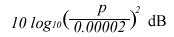
*2 Frequency weighted is A characteristic whose unit is dBA.
- © ONO SOKKI CO., LTD. 1996-2026
© ONO SOKKI CO., LTD. 1996-2026 |
Terms of use | Privacy policy