


- HOME
- Ono Sokki's Patio
- Octave


Octave
Ken: When you told me that the unit of noise level is dBA in
talking of Pascal and decibel. When I was waiting for a
bus in a station, the sign on a tower in planting in
front of the station showed noise level at that moment
with dB.
I first thought it was A characteristic because it was
a noise level but actually it was without A on the
sign.
Dad: The noise level should have come with A because it is
A characteristic. dB reminds people of sound unit
but they may wonder what it is with A. Phon used to
be common as well but dBA was standardized since 1997.
The way of saying Noise level is distinctive to Japan.
It is called A characteristic weighted frequency sound
pressure level.
Ken: How long the name is! Noise level is easy to remember and use.
Dad: Noise level is very useful indeed. A lot of noise consists of complicated frequency ingredients and gets higher and lower as time passing. This is excellent as responses of human being for the complicated noise can be shown numerically with one value.
Ken: You told me for quite some time now that there are frequency masking and time masking in human perception of sound. Does noise level include those effects as well?
Dad: No, it doesnt. There is an amount of estimation called Loudness showing the loudness of sound. Masking is considered with it and it treats the loudness which human senses precisely. However, the calculation is very complicated and equipment to measure it is not common so far. In these days loudness has come to be used for the noise discharged from a machine when estimating sound from an OA equipment or inside of a car. Traffic noise is often estimated with noise level.
Ken: Why is it?
Dad: Sometimes sound discharged from equipment tells you its failure. You call abnormal sound the sound in its working incorrectly. If you estimate with noise level, you can not indicate loudness of sound human can hear precisely. In short, abnormal sound is often an outstanding sound of a certain level of frequency. By considering frequency masking, you can express loudness corresponding to human acoustic sense. In contrast, traffic noise can be estimated with noise level as it includes wide range of frequencies.
Ken: Range of frequencies? It needs to determine by what means you estimate it depending on kinds of noise.
Dad: Yes. When I talked about frequency masking, I related how basal membrane vibrates in a cochlea. The acoustic sense of human is A characteristic but it has a filter to distinguish tone of sound. This filter bandpass is called critical bandpass whose breadth is of approx.1/3 of an octave.
Ken: I dont quite
understand. There is a filter in humans acoustic sound distinguishing
tone of sound. You said 1/3 of an octave
what is it?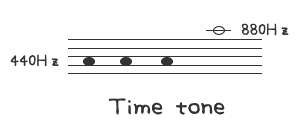
Dad: You know an
octave, dont you? A range from the note Do to the next Do accounts
for one octave. The span of an octave accounts for twice in terms of
frequency. The sound of time tone is the note La but the first three
are all 440Hz and the last long one is 880Hz which is one octave higher.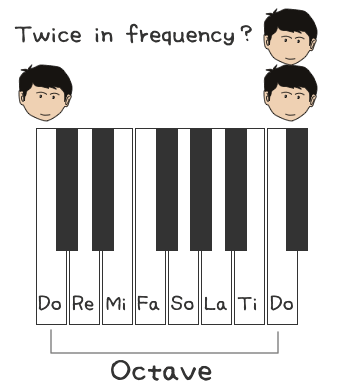
Ken: Which sound is 440Hz with a guitar?
Dad: The sound at the fifth fret of the first chord. One fret is semitone, so the next La note is at the 17th fret of the first chord. There are 12 semitones in one octave. This means a semitone accounts for 1/12 of an octave.
Ken: 1/3 of an octave contains 4 semitones and 2 whole tones. This is between the notes Do and Mi.
Dad: You are right. An octave accounts for twice in terms of frequency. To analyze sound, center frequency which standardizes 1000Hz is used instead of sol-fa. 63Hz, 125Hz, 250Hz, 500Hz, 1000Hz, 2000Hz, 4000Hz and 8000Hz A while ago, I told you that human being can hear sound ranging approx. from 20Hz to 20kHz, but actual sounds surrounding a living environment range from 63 to 8000Hz. So it is common to estimate between these 8 bands.
Ken: What is a band?
Dad: I havent talked to you about it, have I? Bandpass of frequency with one octave breadth is called octave band. I wont tell you in detail as calculating formula is too difficult. An octave band whose centering frequency is 1000Hz has a breadth from 770Hz to 1410 Hz and band whose centering frequency is 500Hz has one from 355Hz to 710Hz. Level of sound strength which is in one octave is called Octave band level. When you analyze sound, it is the easiest to estimate with only one value of noise level expressing with dBA. However, you can not tell if it is low frequency sound with high volume or high frequency sound with high volume. In order to see octave band or see more closely, analyzing 1/3 octave band enable you to understand the characteristic of frequencies of the noise.
Ken: But for what do you have to analyze in such a way? You can estimate by noise level if it does not include abnormal sound, cant you?
Dad: Think a situation to take measures against noise. When you find a level at each frequency, you find which noise of frequency you need to take care of. For example, when measuring noise of road with not only noise level but also measured figures in octave band, you can estimate what kind of design of sound barrier is most effective or how extent the level is around the residential area nearby.
Ken: I see. Noise level is enough in estimation but considering measurements and precaution, analyzing an octave band is effective.
- © ONO SOKKI CO., LTD. 1996-2026
© ONO SOKKI CO., LTD. 1996-2026 |
Terms of use | Privacy policy