


- HOME
- Ono Sokki's Patio
- Floor imapact sound


Floor imapact sound
Ken: I heard that there will be a meeting of apartment-management-association today at Jim’s house at the third floor of the condominium behind our house. According to him, the association has several noise complaints among neighbors, who live at above floor and below floor. They have hard time in solving this complaint by the belows, who suffer from noise caused by the above. Dad, you are engaged in the job of measurement and analysis of noise and vibration at the company, don’t you? Why does the noise go through the thick slabs or walls between rooms? How can we prevent this kind of noise?
Dad: People including
you, Jim and I live in environments which can be roughly defined as
houses, schools or offices or outside surroundings such as roads or
parks etc. People hope that they want to live in a comfortable space in
any cases. Especially in a house which is required relaxing atmosphere,
they want to live in a quiet space without unwilling noise. In
particular, if there is a student preparing for exam, he can not
concentrate on his study disturbed by the noises such as neighbor’s
chats, music or other miscellaneous noises coming into his room. When
your brother listen to the music by the stereo set at the second floor,
you would say it is annoying in spite that our house is a detached type.
In an apartment where many families live, there may be a different
problem regarding noise than that of a detached house as there is only a
wall or a slab between each family. I often hear a word “floor impact
sound” these days and the problem coming up in Jim’s condominium is the
same one, I suppose…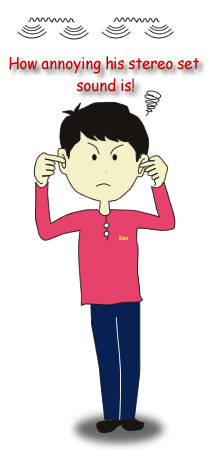
Ken: Well, sound by stereo set in such a loud noise as my brother does make me annoyed. By the way, what do you mean by floor impact sound?
Dad: It is a noise you hear in a room when people make noises by dropping an object on a floor, kid’s running or jumping in a room on the above floor. In moving a chair clattering or dropping a spoon or a coin from a certain height making a sharp noise, such a sound is called floor impact sound (light impact sources). In contrast, there is another kind of noise when a child jumps from a chair or a sofa or pops up and down with a bump. Such a noise is called floor impact sound (heavy impact sources). The former sound causes noise complaints when the floor is made of wood which is used frequently for a condominium floor surface. Wood flooring superseding “tatami floor (Japanese traditional floor)” recently is one of the main reasons for complaint increasing. I think there are many wood flooring rooms in Jim’s condominium as well. In this case, you could solve a problem to some extent by cushioning such as carpeting partially, change a house shoes to a less noise-making type, or put a cushion on the foot of a chair. But in the cases of the heavy impact floor sound, its performance depends on the slab specification, the thickness, area surrounded by beams and a kind of floor slab. Furthermore, to save space for ducts, there is a construction method to leave a certain vacant space between floors supported by clusters. This may deteriorate sound condition. To put matter simple, the heavy impact sound is determined by the design when building a condominium. So it is very difficult to solve this kind of problem. There is no way but neighbor’s communicating to avoid disturbing each other. The best way is to become friends to each other. You will try to meet what your friend wants and you feel easy when you ask a friend for something.
Ken: The best way is to be friends to each other, huh. But isn’t there another way in effect, is there?
Dad:In the case of floor impact sound, it is clear who is making noise and who is suffering from it and this clearness makes problem with no compromising of “one hand washes the other”. Noise depends on sense of respective persons and the level of uncomfortability differs as well depending on health conditions or even one’s mood. Recently as there are increasing problems concerning noise, the standard of noise has been made and started to be indicated. This is called sound insulation grade classifying the insulation of sound. Floor impact sound is defined with “L+ numerical value” and the less the numerical value is, the higher the grade is, showing the condominium has structure with insulation-concerned. This is only for people who is interested in purchasing a condominium and not for people who already have. The condominium where Jim lives must have no such an indication shown as it was not built recently. Condominium is a type of community with many families live in one building and there is no way to live comfortably except to concern each other always keeping in mind as a top priority that they live together.
Ken: I will ask Jim tomorrow if they reach some solution. I hope I can explain to him what dad told me.
<Complement>
There are several kinds of grade for performance of sound insulation and floor impact sound in an apartment defined by Architectural Institute of Japan, JIS and Performance level for housing and each are used without uniformity at this moment. Shown below is an example of Architectural Institute of Japan which is most commonly used as the floor impact sound grade.
Sound insulation grade and actual feeling for floor impact sound (Architectural Institute of Japan)
Sound Insulation grade |
L-40 | L-45 | L-50 |
| Running aroundJump up and down | Hear slightly but it sounds from far. | Can be heard but scarcely to be disturbed | Hear slightly |
| Moving a chair or dropping an object | Hardly hear | Hear only a little | Can be heard |
| Actual feelingEnsure privacy |
|
|
|
- © ONO SOKKI CO., LTD. 1996-2026
© ONO SOKKI CO., LTD. 1996-2026 |
Terms of use | Privacy policy