


- HOME
- Ono Sokki's Patio
- Doppler Effect


Doppler Effect
Ken: Dad, I learned Doppler effect in a science class today. I know from my own experience that the pitch of an ambulance siren differs between when its approaching and leaving but the teacher did not explain how it differs because it is too difficult for us to understand, he said.
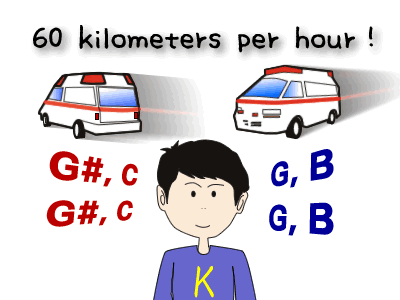
Dad: You call Doppler effect a situation when a frequency of a sound changes while a source of the sound is moving. The easiest example is an ambulance siren as you mentioned. For instance, an ambulance moves about 17 meters per second in driving at a speed of 60 km per hour, which is 60,000m/3,600 sec. Sound travels about 340 meter per second. When it approaches, sound reaches 5% faster than when it leaves and sound leaves 5% slower than when it approaches. There is a difference by 10% in frequency.
Ken: That is how the tone of siren changes.
Dad: There are two sounds, 770Hz and 960Hz in ambulance siren. They are close to So (783Hz) and Ti (987Hz) in musical scale. A man with an absolute pitch hears the sound So, Ti, So, Ti when an ambulance stops wailing siren. If it approaches at 60 kilometers per hour, the sound becomes higher by 5% as I mentioned. The sound changes by a semitone, sounding So#, Do.
 Ken: Then a man with an absolute pitch finds the speed of an
object giving out a sound in approaching and leaving
him, doesnt he?
Ken: Then a man with an absolute pitch finds the speed of an
object giving out a sound in approaching and leaving
him, doesnt he?
Dad: What you understand is right in principle. A man tells a speed if he finds the change of frequency. This is correct not only for sound but light. A wave of light looks bluish as it is compressed in approaching. On the contrary, as it leaves faster, it looks more reddish. Light spectrum shifting to be red by Doppler effect of light is called redshift, and to be blue is called blueshift. The fact that the universe is bloating was found since the redshift was seen far out in the universe.
Ken: I first thought that Doppler effect was only for ambulance siren phenomenon but it is actually utilized for universe observation as well.
Dad: There is another interesting story. Did you know there is an animal which hunts with Doppler effect of supersonic ray?
Ken: An animal judging by sound, well, it has no sight, doesnt it? It is a bat?
Dad: Yes, it is. It has marvelous hearing. It observes a distance from or a speed of a game such as an insect, by hitting pulse wave of supersonic ray which is approx. 60kHz.
Ken: What does pulse mean?
Dad:It means a wave of short time width. A bat uses a sound which sounds for dozens of millimeter second, or approx. 0.03 second. When it approaches an insect, it shortens the time width of a pulse and gives out the pulse continuously.
Ken: How does it find a distance or a speed by hitting pulse?
Dad: By catching a pulse wave of supersonic ray reflecting from a game, it can tell a distance from a target, its speed and direction, the size or the characteristic of its surface.
Ken: I see. Finding a distance from a game by calculating the time of reflection wave coming back, it can calculate the speed with Doppler effect of reflecting wave. Doppler effect is so interesting, isnt it?
Dad: Yes, it continues interest from the view point of natural science; it is also very useful in the field of industry utilizing the phenomena I mentioned now.
- © ONO SOKKI CO., LTD. 1996-2026
© ONO SOKKI CO., LTD. 1996-2026 |
Terms of use | Privacy policy