


- HOME
- Ono Sokki's Patio
- Analog and digital


Analog and digital
Ken: Dad, I did not think much about the encoding when you explained to me the other day but what is encoding digital of CD and MD in particular?
Dad: Before talking about sound encoding, I will tell you the difference between analog and digital taking a clock as an example. Analog clock shows time passing by moving hands continuously. In contrast, digital clock shows the time numerically. By analog clock you can tell the time between graduations to some extent by the location of the hands because the hands move continuously. But by digital clock, you can not read other than the information shown. If it shows seconds as well, you can tell more precisely, but not more than it shows since even duration of one second has endless moments, and you can not show each of them numerically. When you try showing a consecutive phenomenon digitally, there is a process that you section time span (sampling), quantify each part (quantization) and indicate it (encode).
Ken: I see. We often use the word “digital” but now I understand it means representative numerical value as a resultant of sectioning the continuous phenomenon. Recording music digitally means sampling, quantifying and encoding the sound changing continuously.
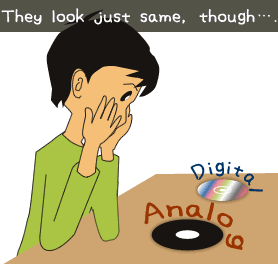
Dad: You see, comparison between gramophone record and compact disc will tell you the difference between analog and digital. Wave pattern of music is recorded as it is on gramophone record or tape cassette. Gramophone record has the same mechanism in principle as the way to carve ditch on the wax canal and picking sound with needles out of it, which Edison devised. CD has a totally different way to record sound. The interval of the sampling which I talked about a clock is about 23 micro seconds, in other words, 44,100 times per second. This interval of sampling determines the upper bound when being played. If it is a signal which contains up to X Hz frequency sound, take twice sampling (2X) or more.
Ken: You told me that the upper bound of the frequency human can hear is 20000 Hz. It means that CD contains sounds of any level of frequency people can hear, doesn’t it?
Dad: Yes, you are right. In contrast, gramophone record contains the sounds of any frequency as it is made without sampling.
Ken: I wonder why people usually say CD has better quality of sound
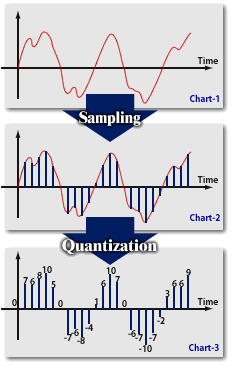 Dad: It
is because there is a secret in quantifying process of sound
after sampling. Let me draw a picture. The original sound
has this kind of wave for instance, which is analog because
it is continuous (Chart-1). Sampling with 441,000 Hz (44,100
times per second) (Chart-2) and then quantize it (Chart-3).
In quantizing, the breadth of a wave is shown with integral
numbers between -32768(-2 to the 15 power) and 32767(2 to
the 15 power -1). You have seen such as 16 bit or 24 bit as
a dynamic range in a specification of audio apparatus,
haven’t you? Bit is a digit number indicated with notion
system of base 2. CD has 16 bit as it has a breadth of 2 to
the 16 power.
Dad: It
is because there is a secret in quantifying process of sound
after sampling. Let me draw a picture. The original sound
has this kind of wave for instance, which is analog because
it is continuous (Chart-1). Sampling with 441,000 Hz (44,100
times per second) (Chart-2) and then quantize it (Chart-3).
In quantizing, the breadth of a wave is shown with integral
numbers between -32768(-2 to the 15 power) and 32767(2 to
the 15 power -1). You have seen such as 16 bit or 24 bit as
a dynamic range in a specification of audio apparatus,
haven’t you? Bit is a digit number indicated with notion
system of base 2. CD has 16 bit as it has a breadth of 2 to
the 16 power.
Ken: What does it have to do with the fact that CD is said to have better quality of sound than gramophone record?
Dad: Aside from whether CD’s better sound, CD has less noise. A dynamic range of 16 bit has a range of 96 decibels. It has a bit narrower range of sound strength than the one acoustic sense of human’s ear can sense but considering a general sound being played and other sounds surrounding (called background noise), there is enough range and you could say noise is unheard.
Ken: I have never listened to a sound of gramophone record directly but I have listened to one when I watched a TV program in which a gramophone record was played. I heard burst noise and that was the difference than CD, right?
Dad: Yeah, gramophone works well when it is new but it gets a noise once scratched only a bit. CD does not have this problem and it is convenient that you can skip numbers when you like. But even today there are many analog fans who are in favor of a movement to put a needle on it and its sound with distinctive noise and insist gramophone record has better sound than CD. You can not tell which sound is better as everyone has his taste on sound and can not judge easily only with frequency or level.
- © Copyright. ONO SOKKI CO., LTD. All Rights Reserved.
© Copyright. ONO SOKKI CO., LTD. All Rights Reserved. |
Terms of use | Privacy policy